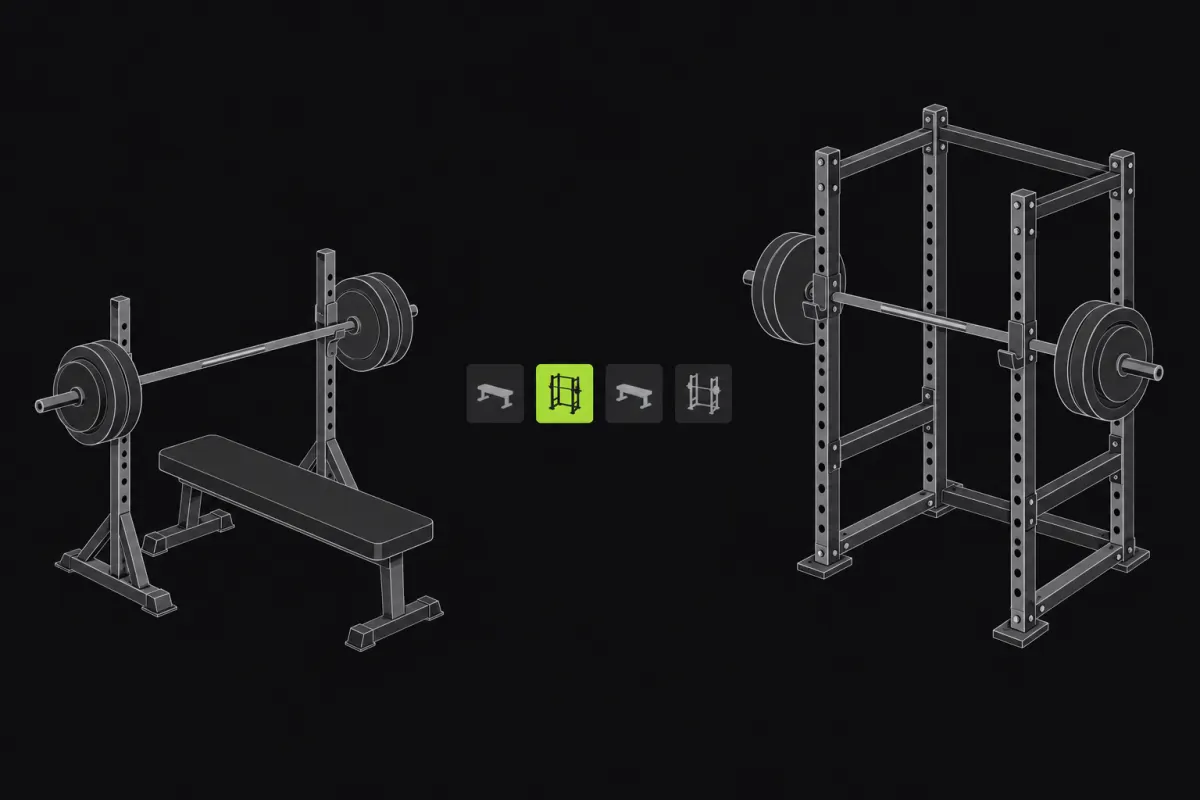
Upper body one day, lower body the next
An upper/lower split alternates upper-body and lower-body sessions, usually four days a week, so each major muscle group is trained twice. A common layout is upper on Monday and Thursday, lower on Tuesday and Friday, with the weekend free. Each session trains half the body, and the week still covers everything twice.
It suits lifters who can reliably train four days and want each session to have a clear job. It is not the only effective structure: when weekly sets are similar, research comparing training frequencies has not found a clear winner. Choose the split you can repeat for months, then judge it by your log.
The four-day program
This is a sample eight-week block written by Brolic, not a prescription. Two upper and two lower sessions alternate a heavier compound pattern with moderate-rep accessory work. Sets are working sets; add warm-up sets before the first heavy exercises of each session and record them separately.
A typical week
- Mon Upper A Bench, row
- Tue Lower A Squat, RDL
- Wed Rest
- Thu Upper B Incline press, row
- Fri Lower B Hack squat, hip thrust
- Sat Rest
- Sun Rest
| Exercise | Sets × reps | Rest |
|---|---|---|
| Bench press (barbell) | 3 × 6–10 | 2½ min |
| Bent-over row (barbell) | 3 × 6–10 | 2 min |
| Seated overhead press (dumbbell) | 2 × 8–12 | 90 s |
| Lat pulldown (cable) | 2 × 8–12 | 90 s |
| Triceps pushdown (cable) | 2 × 10–15 | 60 s |
| Biceps curl (EZ bar) | 2 × 10–15 | 60 s |
| Exercise | Sets × reps | Rest |
|---|---|---|
| Squat (barbell) | 3 × 6–10 | 3 min |
| Romanian deadlift (barbell) | 3 × 8–10 | 2½ min |
| Leg extension (machine) | 2 × 10–15 | 60 s |
| Seated leg curl (machine) | 2 × 10–15 | 60 s |
| Standing calf raise (machine) | 3 × 10–15 | 60 s |
| Exercise | Sets × reps | Rest |
|---|---|---|
| Incline bench press (dumbbell) | 3 × 8–12 | 2 min |
| Seated row (cable) | 3 × 8–12 | 90 s |
| Lateral raise (cable) | 3 × 12–15 | 60 s |
| Face pull (cable) | 2 × 12–15 | 60 s |
| Hammer curl (dumbbell) | 2 × 10–15 | 60 s |
| Overhead triceps extension (cable) | 2 × 10–15 | 60 s |
| Exercise | Sets × reps | Rest |
|---|---|---|
| Hack squat (machine) | 3 × 8–12 | 2½ min |
| Hip thrust (barbell) | 3 × 8–12 | 2 min |
| Bulgarian split squat (dumbbell) | 2 × 8–12 per leg | 90 s |
| Lying leg curl (machine) | 3 × 10–15 | 60 s |
| Seated calf raise (machine) | 3 × 10–15 | 60 s |
Each rep range is a target, not a promise: aim to finish most working sets with about one to three reps in reserve, and keep the range of motion the same from week to week. Substitute an exercise when the equipment is taken or a movement does not suit you, then keep the substitute for the rest of the block so the history stays comparable.
How the weekly sets add up
Counting sets shows what a program actually emphasises. The table uses the same convention as the weekly set tally: a set is direct when the muscle is a primary target, indirect when it assists, and the fractional total counts indirect sets at half value. The classification is a bookkeeping estimate, not a measurement of stimulus.
Fractional sets per week in this program
- Direct sets
- Indirect sets, counted at half
| Muscle group | Direct | Indirect | Fractional | Where they come from |
|---|---|---|---|---|
| Chest | 6 | 0 | 6 | Bench 3, incline press 3 |
| Back (lats and upper back) | 10 | 0 | 10 | Rows 6, pulldown 2, face pull 2 |
| Shoulders | 5 | 6 | 8 | Overhead press 2, lateral raise 3; presses count as indirect |
| Biceps | 4 | 8 | 8 | Curls 4; rows and pulldowns count as indirect |
| Triceps | 4 | 8 | 8 | Pushdown and extension 4; presses count as indirect |
| Quadriceps | 10 | 0 | 10 | Squat 3, hack squat 3, split squat 2, leg extension 2 |
| Hamstrings | 8 | 3 | 9.5 | Romanian deadlift 3, leg curls 5; hip thrust as indirect |
| Glutes | 3 | 11 | 8.5 | Hip thrust 3; squats, split squats and Romanian deadlifts as indirect |
| Calves | 6 | 0 | 6 | Standing and seated raises |
Quads, hamstrings and the back get the most direct work; chest, arms and shoulders sit lower. That is a reasonable starting point for four sessions a week, not a ceiling. If a muscle matters more to you, adding one set to one of its exercises in each session is a simple change, and the tally will show the new total. Change one thing at a time and give it a few weeks in the log.
Why train each muscle twice a week
A 2016 meta-analysis by Schoenfeld and colleagues pooled 10 trials comparing a muscle trained once a week with training it two or more times. Training at least twice a week produced more growth on average, which is where the common “twice a week” advice comes from.
The same group’s 2019 update of 25 studies added a crucial distinction. When weekly volume was equal, training frequency did not significantly change muscle growth; frequency helped mainly by fitting in more sets. Splitting the week into two upper and two lower days is a convenient way to spread the work, not a special stimulus of its own.
The split itself follows the same pattern. Ramos-Campo and colleagues (2024) pooled 14 studies of 392 adults and found similar strength and muscle-size changes from split and full-body routines with volume matched. The one trial we found that compared an upper/lower split directly, Pedersen and colleagues (2022), trained 50 untrained women for 12 weeks either four days a week upper/lower or two days full body, every muscle twice a week either way. Strength and muscle mass changed similarly in both groups. It was one trial, in beginners.
Pelland and colleagues (2026) modelled weekly sets and frequency across 67 studies and 2,058 people. More weekly sets went with more growth and strength, with diminishing returns. Frequency mattered more for strength than for size. Counting indirect sets as half a set fitted the data best, which is the convention in the table above. These are averages across study populations; they cannot tell you your own best number.
Add weight with double progression
Every exercise above has a rep range, and the same rule moves each one forward. Keep the weight until every working set reaches the top of the range with good technique, then add the smallest increase available and start again near the bottom. That is double progression: reps first, then weight.
| Week | Load | Reps by set | Decision for next week |
|---|---|---|---|
| 1 | 80 kg | 10 / 9 / 8 | Keep 80 kg |
| 2 | 80 kg | 10 / 10 / 9 | Keep 80 kg |
| 3 | 80 kg | 10 / 10 / 10 | All sets at the top: add 2.5 kg |
| 4 | 82.5 kg | 8 / 7 / 7 | Keep 82.5 kg and build reps again |
This is a hypothetical lifter, not a forecast. Some weeks stall or go backwards; record them as they happened rather than rounding them up. When the top of the range stops moving for several sessions, review sleep, effort, rest and exercise order in your notes before changing the program.
Upper/lower, full body or push/pull/legs?
All three can train every muscle twice a week. The differences are mostly practical: how many days you have, how long each session can be, and what happens to the week when a session is missed.
| Split | Days per week | What each session covers | If you miss a day |
|---|---|---|---|
| Full body | 3 | Everything, with fewer sets per muscle each time | Each muscle still gets the other sessions |
| Upper/lower | 4 | Half the body, moderately long sessions | One half of the body loses one of its two sessions |
| Push/pull/legs | 6 (or 3 for once a week) | A third of the body, shorter sessions | Needs six days to reach twice a week |
If you can train only three days, rotate the four sessions in order (Upper A, Lower A, Upper B, then Lower B the following week) and accept that each muscle is trained about one and a half times a week. Keeping the order matters more than keeping the weekday.
Common questions
Is an upper/lower split good for beginners?
It can be, if four days a week is realistic. A three-day full-body plan is an equally reasonable start. Consistency, sensible rep ranges and a clear progression rule matter more than the split itself.
Is upper/lower or push/pull/legs better?
Neither is better in general. With similar weekly sets, the research on training frequency points to similar results. Upper/lower reaches twice a week in four days; push/pull/legs needs six.
What if I miss a session?
Do the next session in the sequence rather than doubling up. If you miss often, a three-day rotation or a full-body plan may fit your week better.
How long should I run the program?
The sample is written as an eight-week block. At the end, compare your first and last weeks for each exercise before deciding what to change.
Do warm-up sets count toward the weekly totals?
No. The table counts working sets only. Log warm-ups separately so they do not inflate the weekly tally or muddy the progression decision.
Sources & method
Written by the Brolic team. These references explain the evidence and assumptions; this page does not replace individualized professional advice.
- Schoenfeld et al. — Training frequency and muscle hypertrophy (2016) — Meta-analysis of 10 trials comparing a muscle trained once versus two or more times a week.
- Schoenfeld et al. — How many times per week should a muscle be trained? (2019) — Meta-analysis of 25 studies separating volume-equated from non-equated comparisons.
- Ramos-Campo et al. — Split versus full-body resistance training (2024) — Meta-analysis of 14 studies in 392 adults, with volume matched.
- Pedersen et al. — Split-body versus full-body training in untrained women (2022) — Twelve-week randomised trial of a four-day upper/lower split against two full-body days.
- Pelland et al. — The resistance training dose response (2026) — Meta-regressions of weekly sets and frequency across 67 studies and 2,058 people.