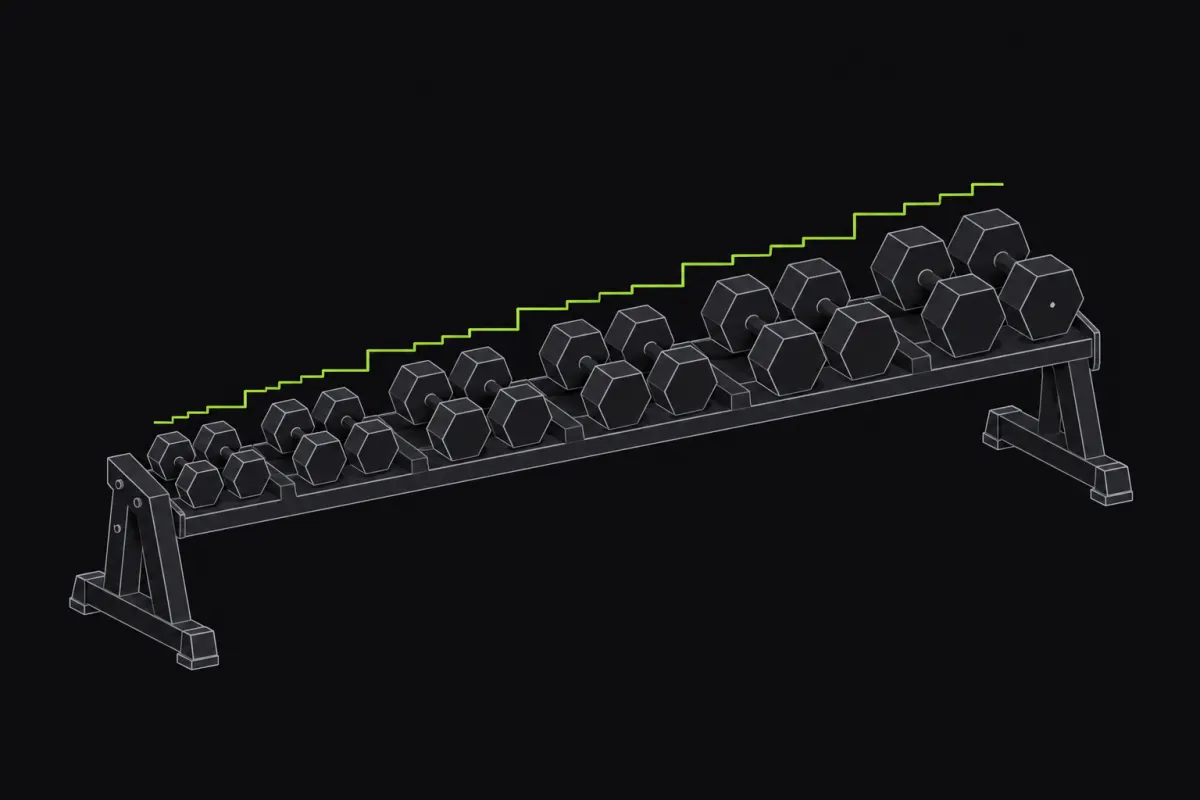
Add reps within a range, then add weight
Double progression means you progress two things in turn: first the reps, then the weight. Pick a rep range, such as three sets of 8–12. Keep the same weight until every working set reaches the top of the range with good technique and the effort you planned. Then add the smallest weight increase available, drop back towards the bottom of the range, and build the reps again.
The appeal is that the next decision is always written in your log. You do not need a percentage chart or a coach’s call to know whether today is a day to add weight: the reps from last session decide it. You can use it with dumbbells, machines and barbells.
A worked log: six sessions of one exercise
This is a hypothetical lifter, not a forecast of anyone’s progress. The exercise is an incline dumbbell press, three sets of 8–12, about two reps in reserve, two minutes’ rest. The load is per dumbbell.
Six sessions of 3 × 8–12, one bar per set
- 22 kg per dumbbell
- 24 kg per dumbbell
S122 kg
S222 kg
S322 kg
S424 kg
S524 kg
S624 kg
| Session | Load | Reps by set | Total reps | Next session |
|---|---|---|---|---|
| 1 | 22 kg | 12 / 11 / 10 | 33 | Same load |
| 2 | 22 kg | 12 / 12 / 11 | 35 | Same load |
| 3 | 22 kg | 12 / 12 / 12 | 36 | Every set at 12: go to 24 kg |
| 4 | 24 kg | 10 / 9 / 8 | 27 | Same load |
| 5 | 24 kg | 11 / 10 / 9 | 30 | Same load |
| 6 | 24 kg | 12 / 11 / 10 | 33 | Same load |
Notice session 4. Total reps fell from 36 to 27 because the load went up; nothing in the log suggests the lifter got weaker. A log that only tracks total reps or volume load would make the planned increase look like a bad day. Record the load change and the reason next to it.
Choose the range and the jump together
The rep range has to be wide enough to absorb your smallest available increase. Going from 22 kg to 24 kg dumbbells is a jump of about 9%, which typically costs a few reps per set. A range of 8–12 leaves room for that; a range of 10–11 would not.
- Heavy compound lifts: narrower, lower ranges such as 5–8 or 6–10 work because a 2.5 kg jump on a heavy barbell is a small percentage.
- Dumbbells and small isolation lifts: wider ranges such as 10–15 or 12–20 absorb jumps that are large relative to the load.
- Machines: stack increments vary by machine. Note which machine you used, because the same pin number is not the same load elsewhere.
Define “the top of the range” before you start: the reps, the technique standard and the effort. If a set reaches 12 only because the range of motion shrank, it has not reached the top. The RIR chart gives a consistent way to write the effort down.
Standard and dynamic double progression
In the standard version above, all working sets move together: the load goes up only when every set reaches the top. In dynamic double progression, each set progresses on its own. When set 1 reaches the top of the range, set 1 gets the heavier load next session while sets 2 and 3 stay where they are until they reach the top too.
| Session | Set 1 | Set 2 | Set 3 |
|---|---|---|---|
| 1 | 22 kg × 12 | 22 kg × 11 | 22 kg × 10 |
| 2 | 24 kg × 9 | 22 kg × 12 | 22 kg × 11 |
| 3 | 24 kg × 10 | 24 kg × 8 | 22 kg × 12 |
The dynamic version: each set moves up on its own
- 22 kg per dumbbell
- 24 kg per dumbbell
S1Sets 1–3
S2Set 1 up
S3Set 2 up
The dynamic version moves some weight up sooner and helps when the next increment is large. The cost is a busier log: sets within one exercise now have different loads, so record the load on every set rather than once per exercise. The standard version is simpler to follow and to review.
The earliest written description of the dynamic version we could find is strength coach Brian Minor’s 2019 article, which also holds effort constant on every set. Coaches progressed sets individually before it had a name, and no published study has tested it against the standard version.
What the research supports
Double progression is a coaching method, and no trial has compared it head to head with every alternative. Three pieces of evidence support its logic. The American College of Sports Medicine’s 2009 position stand suggested adding 2–10% to the load once a lifter can perform one or two repetitions more than the target, which is close to “reach the top of the range, then add weight.” The 2026 update, an overview of 137 systematic reviews, adds perspective: progressing the stimulus is not required to benefit from training, but is probably needed for continued progress over the longer term.
Plotkin and colleagues (2022) randomised 43 resistance-trained adults to eight weeks of lower-body training taken to failure. One group added load while staying within 8–12 reps; the other kept its starting load and added reps. Muscle growth and strength changes were similar, and squat one-rep maxes rose by about 20 kg in both groups. Adding reps is progress in its own right, not only a stepping stone to more weight. It was one short study of leg exercises.
The closest test of the double-progression trigger itself comes from Kassiano and colleagues (2026). In 55 untrained young women doing one-arm triceps extensions, three sets of 8–12 three times a week for eight weeks, arms that added weight whenever they reached 12 reps grew more (triceps thickness +22.9%) than arms that kept repeating the same weight (+11.6%), though both grew. These were beginners doing one exercise, so the size of the gap may not carry over to trained lifters.
When the reps stop climbing
A stall is a flat line in the log for several sessions at the same load, not one bad day. Before changing the plan, check whether the conditions were comparable: the same rest, exercise order, technique standard and effort. Then change one thing at a time.
- Use a smaller jump if one is available, such as fractional plates or the next dumbbell step at a different gym.
- Widen or shift the range, for example from 8–12 to 10–15, so the next increase is reachable.
- Switch to the dynamic version so that one set can move up first.
- Review the week: sleep, total sets and whether other sessions affect this one. A planned lighter week can also help you return to the pattern.
Common questions
How many reps before I add weight?
In the standard version, when every working set reaches the top of the range with the planned technique and effort. In the dynamic version, each set moves up on its own once it reaches the top.
How is this different from linear progression?
Linear progression adds weight at a fixed rate, often every session, with a fixed rep target. Double progression adds weight only after the reps have climbed, so it keeps working after session-to-session weight jumps become too hard to sustain.
Does double progression work for squats and deadlifts?
Yes. Use a lower, narrower range where a small plate increase is a small percentage of the load, and keep the depth or range of motion standard the same so the reps stay comparable.
Should I keep going past the top of the range?
Stopping at the top keeps effort comparable from session to session. If you go past it, record the extra reps; they are real, but they tell you the load is ready to increase.
Do warm-up sets count?
No. Only working sets decide the next load. Log warm-ups separately so they never trigger, or block, an increase.
Sources & method
Written by the Brolic team. These references explain the evidence and assumptions; this page does not replace individualized professional advice.
- American College of Sports Medicine — Progression models in resistance training for healthy adults (2009) — Position stand; suggests a 2–10% load increase once a lifter exceeds the target repetitions by one or two.
- Currier et al. — ACSM position stand on resistance training prescription (2026) — Overview of 137 systematic reviews that updates the 2009 stand.
- Plotkin et al. — Progressive overload without progressing load? (2022) — Eight-week randomised trial in 43 resistance-trained adults comparing load and repetition progression.
- Kassiano et al. — Progressive overload affects the magnitude of muscle hypertrophy (2026) — Eight-week triceps-extension trial in 55 untrained young women; arms assigned to add weight or not.
- Brian Minor — The utility of dynamic/autoregulated double progression (2019) — Coaching article; the earliest description of the dynamic version we could find.