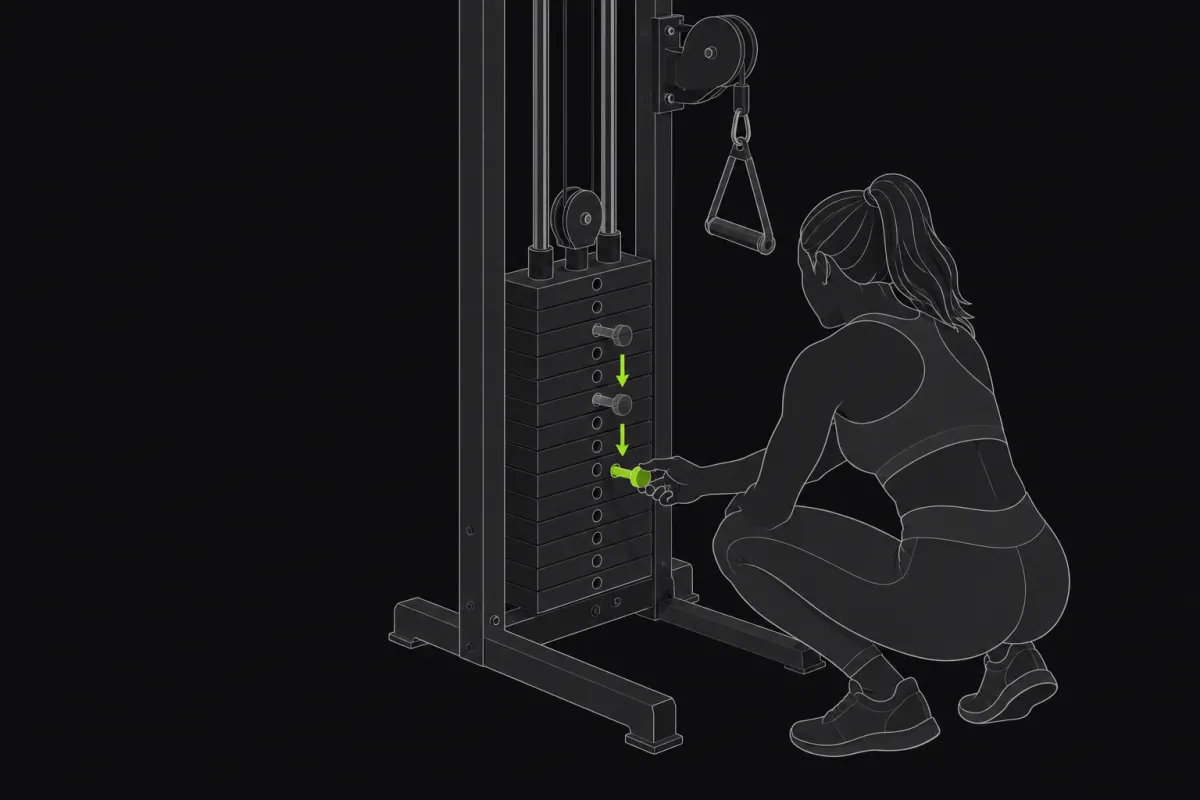
A set that continues at a lighter weight
A drop set is a set you take to or near failure, then continue immediately at a lighter weight for more reps, often more than once. A pushdown at 40 kg for 12 reps might drop to 32 kg for another six or seven, then to 25 kg for a few more, with only the seconds it takes to move the pin.
One drop set, cable triceps pushdown
Top set 12 reps
Drop 1 7 reps
Drop 2 6 reps
In training studies, drop sets built muscle about as well as ordinary sets when the amount of work was similar, and the few trials that timed their sessions found them quicker. They are a time-saving tool, not a shortcut past the rest of your training.
How to do a drop set
- Pick equipment you can change in seconds: a pin-loaded machine, a cable stack or a dumbbell rack. Barbells work if a partner strips the plates.
- Plan the drops before you start. Studies have typically cut the load by roughly 20–30% per drop, one to four times. Write the weights down so you are not deciding mid-set.
- Start with a normal working set at a load you could lift for about 8–15 reps, taken to or close to failure.
- Change the weight and keep going with no deliberate rest, keeping the same range of motion. Stop the drop when technique slips, not just when the target number arrives.
Names vary: “strip sets” strip plates from a bar, and “running the rack” works down a row of dumbbells. Both are drop sets. A mechanical drop set is different: the load stays the same and you switch to an easier variation of the movement, such as moving from a harder to an easier grip or leverage, as described by coach Christian Thibaudeau. It is a coaching technique that has not been tested in a published trial.
What the studies found
Sødal and colleagues (2023) pooled five trials comparing drop sets with ordinary sets, mostly with the total work matched. Muscle growth was similar, with no significant difference between methods. A larger 2026 meta-analysis by Havers and colleagues covered 12 studies, nine of them 6- to 12-week training trials, and again found trivial differences in growth and strength, whether or not work was matched. It also found that drop sets felt harder in the moment: effort ratings and blood lactate were higher.
Individual trials show the range of designs. Fink and colleagues (2018) had 16 young men do triceps pushdowns for six weeks: one 12-rep-max set followed by three drops of about 20%, or three ordinary sets. Triceps growth did not differ significantly between groups, and the drop-set work took about 145 seconds against 316. Angleri and colleagues (2017) compared legs within 32 well-trained men for 12 weeks, with volume matched; 16 of them trained one leg with drop sets. Quadriceps growth was 7.8% with drop sets and 7.6% with ordinary sets. Enes and colleagues (2021) found similar thigh growth across drop sets, rest-pause and ordinary sets in 28 trained men over eight weeks.
Time for the triceps work, Fink et al. (2018)
These trials are small and short, mostly in young men, and each measured only a few muscles. “No significant difference” is not proof that two methods are identical. The fair summary is that drop sets are a reasonable way to fit similar work into less time; the studies do not show they build more muscle.
Where drop sets fit
- When time is short: a drop set can replace several ordinary sets of the same exercise. Only a few trials timed their sessions, so treat the time saving as likely rather than fixed.
- On the last set of an exercise, so the extra fatigue does not spoil sets that follow.
- On isolation and machine exercises, where changing the load is quick and a missed rep is easy to stop.
- Sparingly: because drop sets feel harder, plan where they go in the week rather than adding them to every exercise.
The trials mostly replaced ordinary sets with drop sets rather than adding drop sets on top, so they say little about adding them to a program you already run.
How to log a drop set, and how to count it
Give each drop its own row with its load and completed reps, and mark the rows as one drop set. A single line such as “40 kg × 12 + drops” loses the information you need to repeat it next week.
| Row | Load | Reps | Rest before | Note |
|---|---|---|---|---|
| Top set | 40 kg | 12 | 2 min | About 0 reps in reserve |
| Drop 1 | 32 kg | 7 | Pin change only | 20% lighter |
| Drop 2 | 25 kg | 6 | Pin change only | Stopped when elbows drifted |
This hypothetical set contains 25 reps across three loads. Next week, repeat the same three loads before judging progress, and compare drop sets with drop sets, not with last month’s straight sets.
Counting drop sets in a weekly set tally has no standard answer. Counting the whole drop set as one set understates the work in it; counting every drop as a full set overstates it. Choose a convention, write it in your notes, and apply it every week so your totals stay comparable.
Common questions
How much weight should I drop?
Studies have mostly cut the load by about 20–30% per drop. Aim for a drop big enough to allow several more clean reps; a tiny drop tends to stall after a rep or two.
How many drops should I do?
Trials used between one and four. One or two drops keeps the set short and easy to repeat; each extra drop adds fatigue and time.
Are drop sets better than regular sets for muscle growth?
Not in the studies so far. With similar amounts of work, growth was similar. Their main advantage is fitting that work into less time.
Does every drop have to go to failure?
Many trials took each drop to or near failure, but you can stop a rep or two short. Record your estimated reps in reserve so the next session is comparable. The training-to-failure guide covers the trade-offs.
Is a drop set the same as a superset?
No. A superset pairs two different exercises back to back. A drop set continues the same exercise at a lighter load.
Sources & method
Written by the Brolic team. These references explain the evidence and assumptions; this page does not replace individualized professional advice.
- Sødal et al. — Effects of drop sets on skeletal muscle hypertrophy (2023) — Systematic review and meta-analysis; five pooled trials, all in men.
- Havers et al. — Acute and chronic effects of drop-set training (2026) — Meta-analysis of 12 studies, nine of them 6- to 12-week training trials.
- Fink et al. — Drop sets, acute stress and long-term hypertrophy (2018) — Six-week triceps trial in 16 young men: one drop set versus three sets.
- Angleri et al. — Crescent pyramid and drop-set systems in well-trained men (2017) — Twelve-week, volume-matched leg trial in 32 well-trained men.
- Enes et al. — Rest-pause and drop-set training versus traditional sets (2021) — Eight-week, volume-matched trial in 28 resistance-trained men.
- Christian Thibaudeau — Mechanical drop sets (2018) — Coaching description; no trial has tested mechanical drop sets.